
8/5/2024
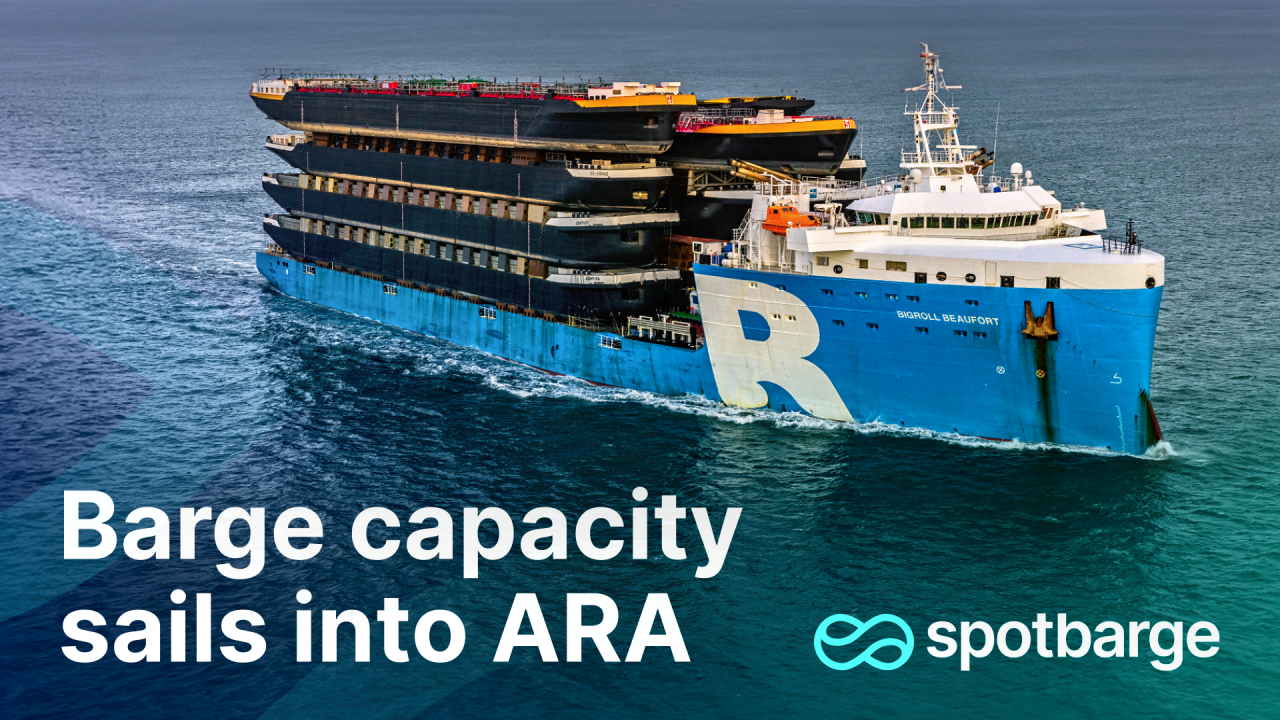
It's like a rugby team of hefty players crashing into a soccer match. A group of 8kt and 12kt barges is entering the CPP ARA barge market adding some serious capacity.
Over the past seven years (2018 to 2024) and today, the CPP barge market has overall been stable and strong, with the exception of the Corona period.
At times there were instances of extreme barge scarcity, in part this was due to low water levels on the Rhine. As a result, prices surged, reaching up to €100k/150k for a trip ARA - Basel and €7-8-9 per tonne in ARA.
Strong demand in the CPP market and profits coupled with low interest rates led some brokers and owners to reinvest profits into building new barges. Remarkable about these newbuilds is their size as well as the number of them being built, considering they will be active in the CPP market.
In 2010, the VT group built the world's largest inland barge, the "Vorstenbosch," with a capacity of 12,000 tonnes.
Nine years later, Somtrans/Vinotra launched a fleet of similar barges, including the Briljant, Somtrans LNG, Smaragd, and Diamant. However, most of these enormous barges are deployed in the DPP market.
Due to their size, these barges are ideal for efficient bunker deliveries, commonly referred to as "milk runs." Since the DPP market typically involves higher volumes per lift compared to CPP, it has made more sense to use these barges for DPP purposes until now.
Currently, there are about 1,350 inland barge tankers in Europe, with a total capacity of 3.7 million tons. Of these, 3.5% are 8,000 tons or more, with a total capacity of 357,500 tons, which is almost 10% of the total capacity (CPP and DPP tankers combined).
An estimate of 12 x 12kt and 20 x 8kt barges will be added to the ARA market which is roughly 304.000 tons. This is quite a significant volume, with these new barges 19% of the total capacity is coming from 8kt+ barges. The first barges are already sailing, and the rest will be delivered gradually over the next two years.
While it might seem that the more volume you can load the more profit you can make, the main reason for using large barges lies in their operational cost (OPEX) and capital expenditure (CAPEX).
The difference in OPEX between a 6,000-tonne barge and a 8,000-tonne barge is not that significant. While the upfront cost (CAPEX) of a larger barge is higher, its increased cargo capacity allows you to transport more goods for the almost same operational cost per tonne. This makes building larger barges a more economical option in the long run.
In the spot market, consistently securing full loads for 8,000-12,000 tonne barges is challenging due to the irregular availability of large cargo parcels.
When sailing to Amsterdam, it's important to consider the draft restriction of 4 meters. A 6,000-ton barge can carry up to 4,500 tons of light products to Amsterdam.
This situation presents an opportunity to enhance product delivery to Amsterdam as it is known as the largest gasoline port in the world. With these barges, 8,000 tons can be taken in one go.
In terms of blending operations, is there a strategic advantage to handling larger volumes, or do they offer no substantial benefits to product blenders?
There is no straight answer; sometimes this is the case and sometimes not.
In low carbon fuels large shipments of 8-10kt occur but it is not a common practice. The main business for these volumes will be in the lights and distillates products.
Low-density products like Naphtha see a particular advantage with larger barges.
For instance; a 18,000-ton Naphtha shipment could be completed using just two large barges, instead of four smaller ones.
It will also improve efficiency; with fewer ships terminals spend less time on mooring/unmooring, hose connection, safety checks, and other procedures.
The operations team benefits from reduced paperwork, customs clearance processes, and broker communication for each additional vessel.
The high demand for CPP barges over the past seven years has resulted in an expansion of capacity in the barge market.
However, it remains uncertain whether the demand will remain high enough to absorb the increased capacity. If not, an oversupply of barges could occur, leading to lower prices.
Moreover, larger CPP barges may compete for smaller cargo volumes, putting pressure on smaller barges to seek new markets, such as the Rhine, provided they have Rhine crew on board.
The newbuilds can compete for smaller cargo volumes. However, the demurrage rate is subject to negotiation depending on market conditions. Since the demurrage rate of these large newbuilds is relatively higher, it’s easier for these barges to bring this rate down compared to a smaller barge.
During a strong market, charterers are more likely to have to pay the applicable demurrage rate for these barges, even when loading smaller parcels.
Newbuilds have been well-received in recent years and were more than welcome. Interesting times lie ahead.
Features
Users
Company
Resources

SpotBarge
© 2026 by Spotbarge B.V. All rights reserved.