
8/5/2024
The port of Rotterdam is the largest bunkering port in Europe and ranks among the top 3 in the world. Annually, approximately 9.5 million tons of fuels are supplied to the shipping industry in Rotterdam. In addition to traditional fuels, the availability of alternative and sustainable fuels is growing.
It is estimated that ships bunker more than 6 million tons of conventional fuels annually in the Port of Antwerp-Bruges. That’s a combined bunker volume in ARA of 15.5 million tons.
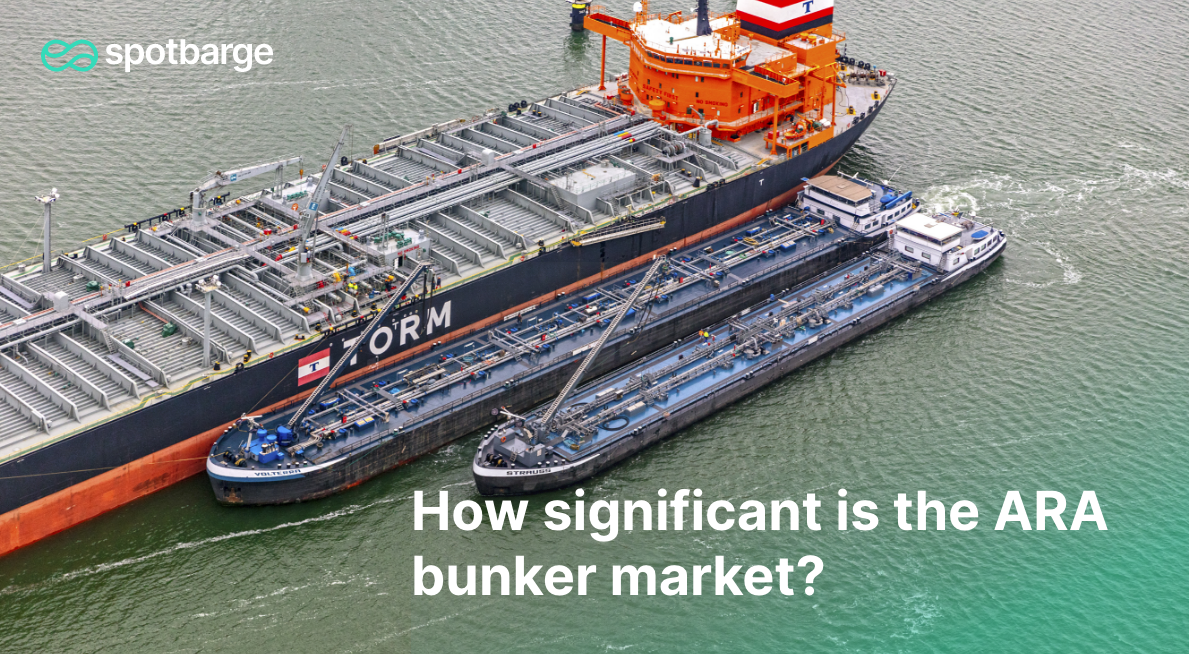
In contrast to Singapore, seagoing vessels in the ARA (Amsterdam-Rotterdam-Antwerp) region are only permitted to bunker within the designated ports. In Singapore, bunker fuels are delivered to ships at open sea. As a result, the methods of bunker delivery differ between the two regions. The restriction of bunker operations within the port presents a significant challenge for bunker companies in scheduling and executing deliveries. This is primarily due to the dynamic and ever-changing nature of sea-going vessels' itineraries, while at open sea a bunker ship can sail to the waiting vessels without having to wait for them to come in port.
A bunker barge is distinct from a regular barge in that it is equipped with a bunker boom (a crane-like apparatus used for transferring fuel), heating capabilities (to maintain the fuel at the appropriate temperature), and a highly-trained and experienced bunker crew to ensure the safe and efficient delivery of fuel.
In ARA region there are sailing approximately 150 DPP (dirty petroleum) barges, whereof +-120 barges in bunkers and the others are flexible in transporting fuel components and bunkers. Almost all companies who are involved in bunker deliveries have these bunker barges on time charter. This is attributable to the tight DPP market and the critical nature of these deliveries. For example, consider a scenario where a bunker delivery of 6000 tons has been missed, due to a delay in the barge's arrival. In such cases, the sea-going vessel will not remain idle and wait. Typically, the laytime for these vessels ranges between 1 to 3 days, making it essential to adhere to the delivery schedules stringently. The subsequent course of action involves the sea-going vessel departing for the next port to receive its bunker supply. However, this turn of events necessitates that the company responsible for the missed initial bunker delivery in Rotterdam bear the financial burden. Specifically, they must compensate for the price difference between the bunker cost per ton in Rotterdam and that of the alternative port. The financial implications of such a situation can be substantial, with the price difference per ton easily reaching up to $10-50$ p/t dependent on the market. This is primarily because Rotterdam is recognised as one of the most low-cost bunker locations globally. This is a typical example of a clause in a bunker contract, however each company has a different approach of how to settle missed bunker deliveries.
The bunkering industry in the ARA (Amsterdam-Rotterdam-Antwerp) region is substantial, with an average bunker price ranging from $500 to $600 per metric ton, depending on market conditions and fuel specifications. This equates to an approximate $8 billion bunker business in the region. While this is a significant figure, margins are generally ranging from $5 to $10 per metric ton. However, these margins can fluctuate depending on the cost of the blend components used in the production of the bunker fuel.
To maintain or improve the profitability of a bunker delivery, it is crucial to optimise the use of bunker barges. For instance, if a barge with a 1,500-ton bunker load is waiting for a delayed seagoing vessel and there is no flexibility to reassign the barge, demurrage costs can quickly accumulate to $10,000 to $15,000 for just two or three days of waiting. This could potentially erase the supplier's profit margin for that delivery. To mitigate this risk, most bunker suppliers have a fleet of dedicated bunker barges and aim to serve a large pool of clients with high-volume demands. This approach allows them to optimise barge scheduling and, in the event of delays, redeploy the barge to another vessel, thereby minimising downtime and demurrage costs.
Bunker barge planning can be a complex and challenging task, as the bunker volumes required by each vessel can vary significantly. Some vessels may only need 1,200 tons of bunker fuel, while others may require 5,000 or 8,000 tons. When the delivery dates and volumes for multiple vessels align, it is possible to combine parcels on a single barge, which can improve efficiency and reduce costs.
However, unexpected changes to a vessel's itinerary can disrupt even the most carefully laid barge plans. For example, a container vessel that was originally scheduled to moor in Rotterdam first may instead be redirected to Hamburg, leaving a fully-loaded barge with nowhere to deliver its cargo. Similarly, seagoing tankers may be forced to wait off the coast of Rotterdam before they can enter the port, and their arrival times can be subject to change based on factors such as waiting for the right selling price or refinery production schedules.
The unreliability of vessel arrival times and the last-minute nature of bunker schedule changes can make barge planning and operations a challenging daily task. It requires a high degree of flexibility, coordination, and expertise to ensure that bunker deliveries are made on time, within budget, and in compliance with all safety and regulatory requirements.
Fuel oil blending is a crucial aspect of marine fuel production, especially in the context of the recent IMO 2020 regulations. The process of blending fuel oil begins with the procurement of the primary blend component, which is typically composed of residual fuels obtained from refineries. Residual fuels are a byproduct of the crude oil distillation process and have been popular in the maritime industry due to their relatively low cost.
However, with the implementation of the IMO 2020 regulations, which require a significant reduction in the sulfur content of marine fuels, the production and blending of these fuels have undergone substantial changes. Refineries have had to adapt their processes to produce low-sulfur residual fuels, and blenders have had to develop new formulations to ensure that the final product meets the required specifications.
In addition to the primary blend component, fuel oil blends may also contain other components, such as distillates or cutter stocks, which are added to achieve the desired viscosity, density, and other physical properties. The blending process itself must be carefully controlled to ensure that the components are thoroughly mixed and that the final product is stable and homogeneous.
The implementation of the IMO 2020 sulfur cap has led many complex refineries to upgrade their operations with advanced units, such as cokers, to minimise the residual part of the crude oil barrel during the distillation process. The goal of this shift is to maximise the production of higher-value products, such as gasoline and diesel, while reducing the output of high-sulfur residual fuels, which have historically been used as marine fuel.
However, the use of these advanced units results in residual fuels with very high densities and viscosities, which can be challenging to use directly as marine fuel. To address this challenge, fuel oil producers incorporate cutter stocks into their blending processes. Cutter stocks are lighter hydrocarbons that are added to the residual fuels to adjust their viscosity, density, and sulfur content.
Common cutter stocks used in fuel oil blending include slurry oil, distillates, vacuum gas oil (VGO), atmospheric residual fuels and many more. The selection of cutter stocks and the blending process itself must be carefully controlled to ensure that the final product meets the stringent requirements of the IMO 2020 regulations, including a maximum sulfur content of 0.50% by weight.
The components utilised for fuel oil blending are often transported via barges between trading houses and (majors) refineries. Occasionally, a DPP barge with a gap in its bunker delivery schedule may be employed for this purpose. However, more frequently, these fuel components are transported by DPP barges that are primarily dedicated to carrying fuel products rather than bunkers, ensuring a more streamlined and efficient logistics process.
Features
Users
Company
Resources

SpotBarge
© 2026 by Spotbarge B.V. All rights reserved.